STEP 0 through STEP 10 in full. Every step carries the common weak answer alongside the version that got fixed, so you can compare your own answer against something rather than against nothing. There are places to write inside it.
Paid — Chapter 1 · Turning a positive into a product
Can your product answer “so what changes for me?”
You have described the features, the page count, the bonuses. What the buyer wanted to know was what happens to them. Bring one thing you sell — or one thing you are about to sell. Who it is for, what hassle it removes, what it costs, where you hand it over. Worked examples and a fill-in workbook help you put it on one page, in nine fields.
- What is left when you finish
- One finished product design sheet, in your handwriting or your own words.
- Format
- 2 PDFs + 1 DOCX (download)
- Extent
- Reader PDF, 69 pages. Workbook PDF, 40 pages. Editable workbook DOCX. Typeset for US Letter.
Allow two to three hours of writing. Start with the sample below to see the reading and the work involved. Then check how to use it with an existing product and price and delivery.
INSIDE THE BOOK / ACTUAL PAGES
Before you buy, see the work you will do.
Read the explanation, fill in the worksheet, compare a worked example. These pages come from the PDFs included with the chapter.
Read 8 free pages (PDF · new tab)Includes reader pp.29–33 and workbook pp.18–19, 32. This is an excerpt, with gaps between selections.
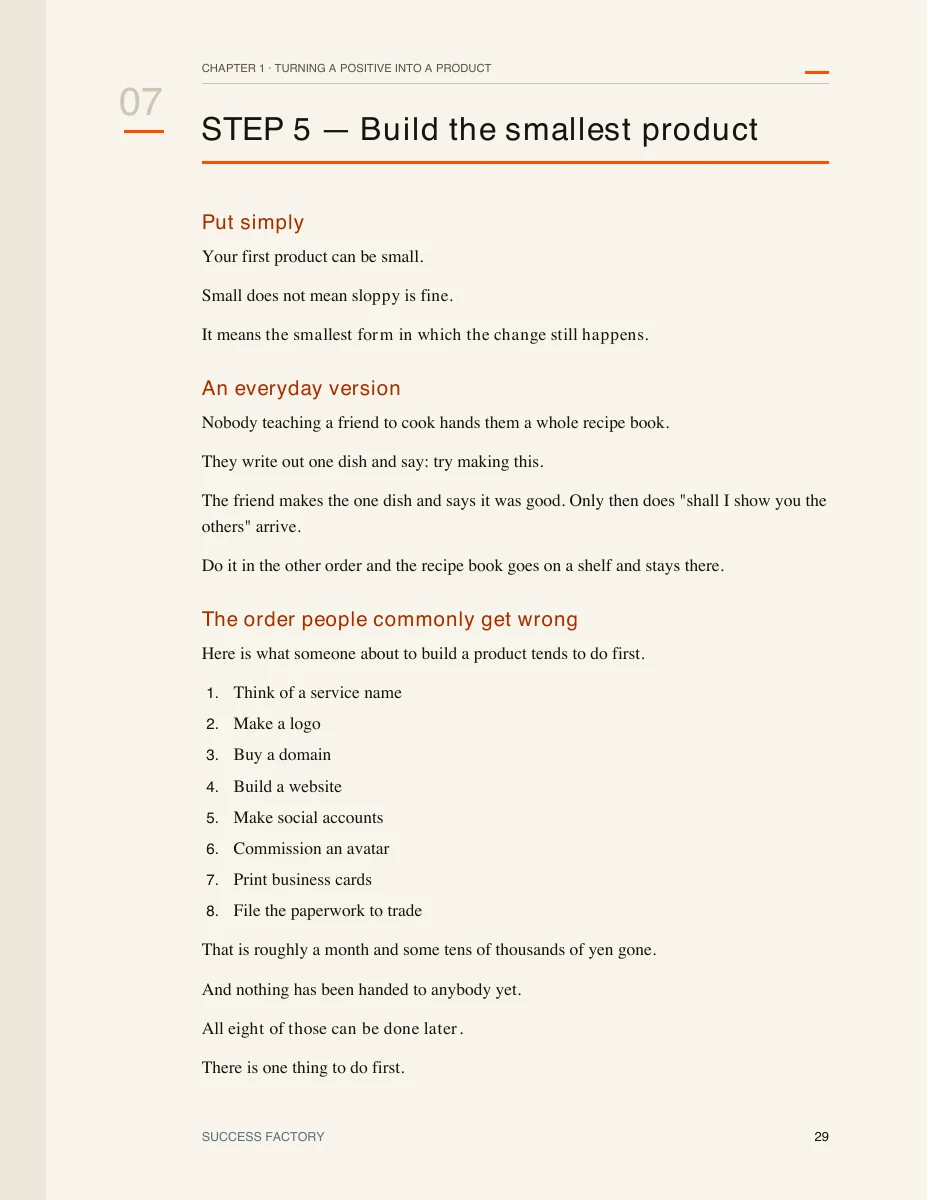
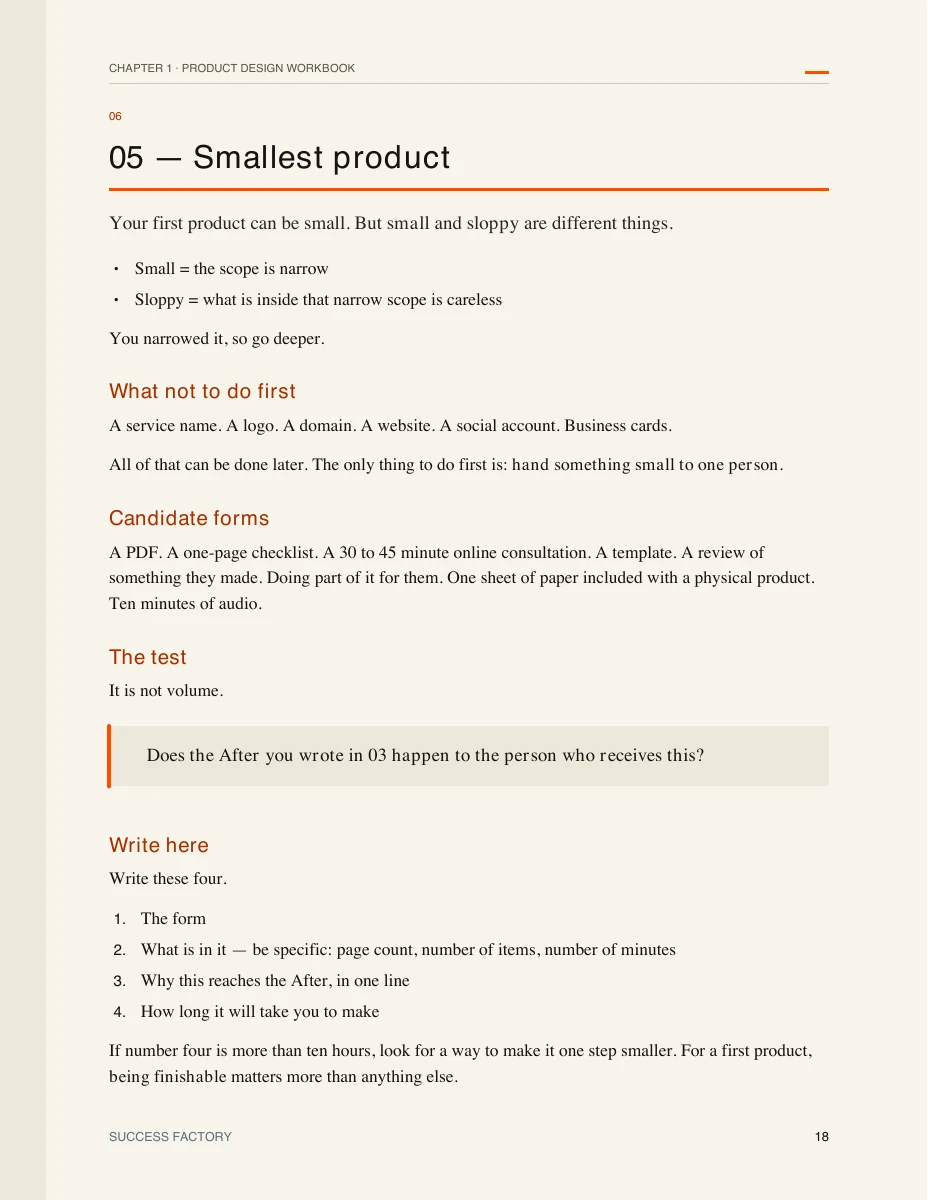
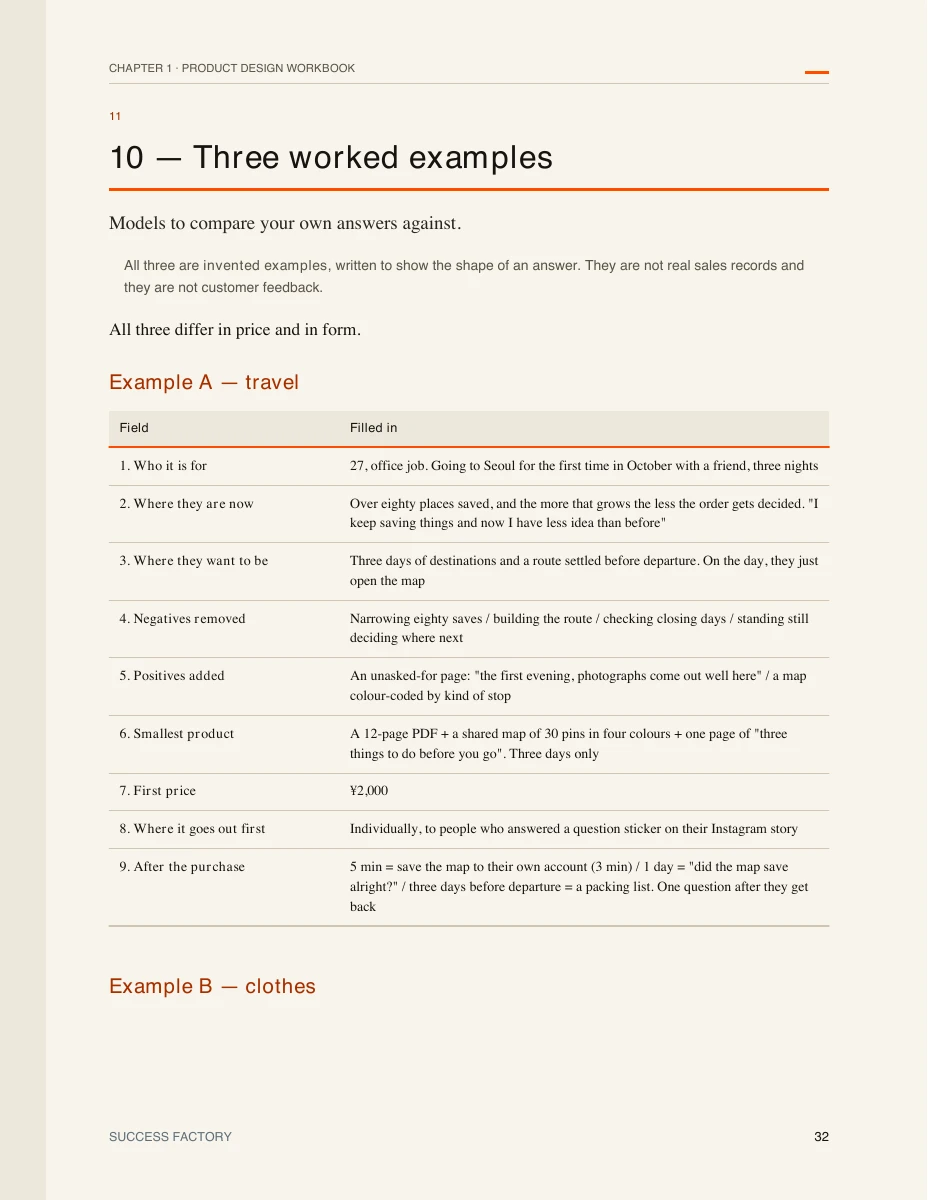
Tap a page to enlarge it. Worked examples are hypothetical designs, not sales records or customer feedback. No sales or income outcome is guaranteed.
Next: price and how delivery worksTHE NEXT STEP
Seen enough to imagine using this for your own product?
Check the price and delivery before deciding whether to continue.
Chapter 1 / 2 PDFs + 1 DOCX (download)US$39The total shown on Stripe's checkout is the amount charged.
The Stripe entity identified on the checkout and the receipt is the Merchant of Record for this transaction: it runs the checkout and the payment, handles the sales tax, VAT or GST that falls inside Managed Payments coverage, and handles support for the transaction itself. That is not a claim that every tax in every country is covered. The product, its delivery and product support remain SUCCESS FACTORY's responsibility: the files are sent by hand to the email address entered at checkout, within 24 hours. This is not automatic delivery. Stripe receives your card details; SUCCESS FACTORY does not.
The charge, the receipt and any refund are handled by the Stripe entity acting as Merchant of Record for the transaction. Files are not delivered automatically: SUCCESS FACTORY sends them by hand, within 24 hours, to the email address you enter at checkout. For a missing delivery or a corrupt file, use the contact shown on your receipt. Change-of-mind refunds are generally unavailable for an immediately readable digital product; statutory rights remain unaffected.
Now, and after you finish
“Nobody understands what I sell” becomes one page.
The free part of this site deals with what selling is. This chapter deals with what, specifically, your product changes and for whom. The subject of the sentence moves from me to you.
Where you are now
- "I do have something for sale on X. But I cannot say in one sentence whose situation it changes, or how."
- You can describe the contents and the bonuses, but not the change after purchase.
- You do not know what order to do things in.
- You do not know how to price it, so it is either free or abandoned.
After you have written it
- One page, nine fields, saying who it is for, what changes, what it costs and where it goes out. You have spoken to your first person and written down what came back.
- Who it is for is one specific person, not a demographic.
- You can explain the price in your own words.
- You know the next thing to check.
The deliverable is not the memory of having read it. It is the page you finished writing.
Which is why it is built so that reading alone does not move you forward. “Write this here” comes up repeatedly. You can skip those and read to the end, and if you do, this chapter’s deliverable will not exist.
Whether you need this
You have something to sell. Can you say whose situation it changes?
This is for the person with a product, or an idea for one, who gets stuck explaining what it does for the buyer. It is not for everyone. Read both lists to decide whether it fits what you need.
Not for you if
- You already know exactly who your buyer is and what to change next when a response comes back
- You want something to read rather than something to fill in
- You are looking for a reliable way to increase your income quickly
- You are looking for audience-growth tactics or advertising operations you can use today
For you if
- You already sell something on X, but cannot say in one sentence whose situation it changes
- You have a product, and the description keeps turning into a list of pages, features and bonuses
- You have experience or a skill, and have never shaped it into something for sale
- You are willing to spend two or three hours actually writing, rather than reading and stopping
If you already know who you are delivering to, can see the responses, and know what to change next, what you need is not Chapter 1. It is the material of Chapter 2, which is about reading what comes back. Chapter 2 is not written yet.
The design sheet — nine fields
These nine fields get filled in.
They are not in order of difficulty. They are in the order where filling in one makes the next one easier to write. That order is itself the content of this chapter.
- 01Who it is forOne specific person, not an age bracket or a job title.
- 02Where that person is nowWhat they cannot do, and what is getting in the way.
- 03Where that person wants to beOften something they have not put into words themselves.
- 04The negatives you removeHesitation, effort, worry, the chance of getting it wrong.
- 05The positives you addSurprise, care, speed, something worth remembering.
- 06The smallest productNot the most impressive version. The version that tests whether the change happens.
- 07The first pricePriced from the distance you closed, not from what it cost you to make.
- 08Where it goes out firstNot ten thousand people. The place your first one person already is.
- 09What happens after the purchaseNot shipping. The route from paying to actually being glad.
Nobody writes these perfectly the first time. Starting with an answer that is too wide, or blurry, is fine. Every step carries a common weak answer next to the version that got fixed, so you have something to narrow your own answer against.
For people already selling
What you already sell is the raw material.
This is not a chapter about starting over. If you already have even one thing out on X, that thing becomes the input to the same nine questions, and the work is rewriting it from the buyer’s side. What you use is the nine questions above and the workbook described in the next section.
- STEP 1Pick exactly one thing you currently sell
Whether it sells well is irrelevant. Picking the one you find hardest to describe is where this chapter moves the most. Do not run several in parallel. This chapter assembles one page.
- STEP 2Put it on the table as material
On worksheet 01, the raw material inventory, put that product and the experience, knowledge and failures inside it. The job of that page is to treat it as unprocessed material rather than as a finished thing.
- STEP 3Rewrite the nine fields from the top
Set the description currently on your sales page aside. Filling in worksheets 02 through 08 rewrites the same product in the shape of the nine fields, and 09 puts them on one page.
- STEP 4Approach one person with the rewritten page
Worksheet 11, the first market test record. Chapter 1 ends at writing down what came back, not at whether it sold.
Which part of your current offer each field rewrites
- 01Who it is forNot "people who might buy". Narrow it to one person who actually bought your current offer — or one who looked and did not.
- 02Where that person is nowWrite what that one person could not do in the moment before they found you. This field describes their state, not your product.
- 03Where that person wants to beIf your current description ends at what is included, rewrite it to end where the buyer stands after they have finished using it.
- 04The negatives you removeList which of the buyer's effort, hesitation, worry and risk your current offer actually absorbs. Whatever is not on that list is the next thing to fix.
- 05The positives you addNot a field for adding volume. Pick exactly one of surprise, care, speed or memorability that your current offer does not have.
- 06The smallest productThe field where your offer gets smaller. Decide whether to keep shipping everything, or to cut it down to the version that tests whether the change happens at all.
- 07The first priceCheck whether you can explain your current price by the distance you close rather than by your costs or by what others charge. If you cannot, either the price or the contents will move.
- 08Where it goes out firstNarrow to one person on X. Not your followers. The one person you wrote down in 01, and the place they already are.
- 09What happens after the purchaseWrite what happens to the buyer immediately after payment, five minutes later, a day later and a week later. This is where you find out whether your offer ends at delivery.
No extra file comes with this route. You receive the same three files described in the next section. The reader is written so that someone starting from experience that is not yet a product can also follow it; if you already have a product, you swap the input from “experience” to “the thing I sell” and run the same order.
What you receive
Three files, and nothing else.
No video and no audio. No members’ area to log into. Only formats you download and keep.
The writing space on its own, in the same order as the reader, from worksheet 00 through 12. Ruled response areas, sized to be printed and filled in by hand.
The same workbook as a real Word document — headings, styles, tables and ruled answer areas you type directly into. Not a PDF pasted into Word. Use this if you would rather not print, or if you expect to rewrite an answer several times.
The reader and the workbook run in the same order. A step you read in the reader is written into the same number in the workbook. Print the PDF if you want to write by hand; use the DOCX if you would rather type, or expect to rewrite an answer several times. You do not have to pick one.
How the English edition differs from the Japanese one
- 01Same chapter. Same nine questions, same three worked examples, same research notes, same boundaries.
- 02Typeset again, not converted. US Letter, English typography, and the workbook’s answer areas rebuilt so they are usable when you type into them.
- 03Yen amounts inside the worked examples are left as yen. Changing an example’s numbers would change what the example demonstrates.
As rendered: the reader runs to 69 pages and the workbook to 40 pages on US Letter.
“Add the positive, subtract the negative” from the free page is applied to this product too. What was added is the worked examples and the order. What was subtracted is the time spent stalled in front of a blank page, and the time spent deciding what to do first.
Not reading. Doing.
You put your hands to work twelve times.
The workbook runs from 00, how to use it, through worksheets 01 to 12. Below are those twelve pages and what is left behind when each is filled in.
- 01Raw material inventoryYour candidate materials are on the table
- 02One-person profile sheet1. Who it is for
- 03Before / After2. Where they are / 3. Where they want to be
- 04Subtract / Add4. Negatives removed / 5. Positives added
- 05Smallest product6. The smallest product
- 06The price staircase7. The first price
- 07The first approach8. Where it goes out first
- 08Five minutes / one day / one week9. After the purchase
- 09Product design sheetAll nine fields on one page
- 10Three worked examplesSomething to compare your answers against
- 11First market test recordWhat came back is written down
- 12Handover to the DIG LOGThe next thing to check is decided
Time, and what to have ready
Two to three hours if you go straight through. Split across days: 01–03 on the first, 04–06 on the second, 07–12 on the third. What you need is paper and a pen, or the notes app on your phone.
If you stop partway, what you already wrote stays written. When you get stuck, go back one worksheet. The reason a field will not fill in is usually in the field before it, not in the field you are staring at.
The times above are how long it takes to finish writing. They do not mean that spending the time makes anything sell. Whether it sells is decided by the market, after you have written it.
Three worked examples
You are shown three finished ones first.
A blank page stops people. So STEP 9 of the reader carries three examples with all nine fields filled in. The price and the format are deliberately different in every one.
- Who
- 27, office job. Has saved past eighty places on Instagram and, the more that number grows, the less the itinerary gets decided.
- Smallest product
- A 12-page PDF and one shared map with 30 pins colour-coded into four kinds of stop. Three days only; day four onward is not covered.
- Why that price
- Because it absorbs the narrowing-down, the ordering of the route and the opening-hours checks that this person would otherwise have done themselves.
- Who
- 34. Moved to an office with no dress code after roughly ten years of uniforms and suits. Leaves a shop within five minutes of walking in.
- Smallest product
- One 45-minute consultation, plus a shopping list of at most nine items built together during the call. The whole wardrobe is not reviewed — only what gets worn this month.
- Why that price
- Because it is not information being handed over. Height, build, budget and the tone of the workplace are asked about first, and then a list is made for that one person.
- Who
- 39. Cooks four times a week. Will buy a ¥1,000 soy sauce, but has never known when an expensive seasoning is supposed to be used.
- Smallest product
- The bottle, a small packet of the cracker that goes with it (200 yen of cost), and one card. No presentation box. Five made to start with.
- Why that price
- Because the price was not built up from cost. It is positioned as a once-a-month pleasure rather than as a replacement for everyday soy sauce.
These three were written for the reader in order to show the shape of an answer. They are not real sales records and they are not customer feedback. The reader carries the same caveat on the same page.
Put side by side, the three show that a higher price is not set by word count or by how much stuff is in the box. It is set by how far the thing was bent toward one specific person. And all three contain one thing the buyer can finish within five minutes.
Self-applied — this product run through its own nine questions
Here are the nine fields, applied to this product itself.
If someone selling a method does not use that method on their own product, there is no reason to buy it. So it is put somewhere you can see before paying. Below are the nine fields filled in for SUCCESS FACTORY Chapter 1, English edition.
- 01Who it is for
Someone already selling a product, a service, information or their own work on X, who cannot say in one sentence whose situation it changes and how. Not for someone who already knows exactly who their buyer is and what to change next when a response comes back.
- 02Where that person is now
Able to describe the contents and the bonuses, unable to describe the change after purchase. No idea what order to do things in. No way to set a price, so it is either free or abandoned.
- 03Where that person wants to be
Holding one page, nine fields, saying who it is for, what changes, what it costs and where it goes out — and having already spoken to one person and written down what came back.
- 04The negatives removed
Time spent stalled in front of a blank page. Time spent deciding what to do first. Having no completed answer to compare your own answer against.
- 05The positives added
The order from STEP 0 to STEP 10. Three worked examples with all nine fields filled in. A common weak answer at every step, next to the version that got fixed.
- 06The smallest product
A reader PDF, a workbook PDF and the same workbook as an editable DOCX. No video, no audio, no members' area, no personal support.
- 07The first price
US$39, in US dollars, before any sales tax, VAT or GST Stripe adds for where you are under Managed Payments coverage. The first price set on this chapter, and a deliberate one: not built up from what it cost to make, but placed where the chapter can be picked up while I find out whether it lands. Page counts and file counts describe the contents; they are not an argument that this number is right. The purpose is written down, but why it is US$39 rather than US$29 is the one still unresolved on this site.
- 08Where it goes out first
One page on this site, at /en/chapter-1. The checkout belongs to Stripe, which is the Merchant of Record for the transaction; the file delivery is an email sent by SUCCESS FACTORY. This site carries no advertising, no analytics and no email capture field, in either language.
- 09After the purchase
Immediately: Stripe sends the receipt for the transaction. Within 24 hours: the three files arrive from SUCCESS FACTORY, at the email address entered at checkout. Two to three hours of work later (or on the third day, if you split it): one page with nine fields filled in. After that: you approach one person, and their words are written down as a record.
What this page is not
This is a worked example of the method applied to this product. It is not a sales record, not a customer's opinion, and not a report of results.
Everything in it comes from what is written elsewhere on this site and from the specification of the delivered files. Before buying, check the nine rows above against the rest of this page. If they disagree, that is a reason not to buy.
Row 01 is not narrowed to the single named person the reader asks for. It stops at what this site can state as fact, which by the book's own standard is an answer with room left to improve.
Row 07 states the price and what it is set low to find out, but not why it is that exact figure. Applying the method to itself leaves the unfilled places visible too.
What you can check before buying is not what I claim. It is the page the method produced.
Buying it, and receiving it
Stripe is the Merchant of Record. SUCCESS FACTORY sends the files.
This product is sold through a Stripe checkout with Stripe Managed Payments enabled. The Stripe entity identified on the checkout and on your receipt is the Merchant of Record for this transaction: it runs the checkout and the payment, handles the sales tax, VAT or GST that falls inside Managed Payments coverage, and handles support for the transaction itself. The product is still SUCCESS FACTORY's: the files are sent by hand, to the email address you enter at checkout, within 24 hours, and questions about the product itself come here.
- STEP 1Press the purchase button
Pressing the button on this page opens Stripe's checkout — a Stripe Payment Link. Nothing is charged and nothing is committed up to that point.
- STEP 2Pay on Stripe's checkout
Payment happens on Stripe's checkout. They receive and store your card details; this site does not, and cannot. On the same screen you enter the email address the files are sent to. Where sales tax, VAT or GST falls inside Managed Payments coverage, Stripe works it out, adds it and collects it, and the total is shown before you confirm. That is not a claim that every tax in every country is covered.
- STEP 3Receive the receipt
When the payment completes, Stripe sends the receipt, and it identifies the Stripe entity acting as Merchant of Record for the transaction. Questions about the charge, the receipt or a refund go to the contact shown on that receipt.
- STEP 4Receive three files within 24 hours
The reader PDF, the workbook PDF and the editable workbook DOCX are sent by SUCCESS FACTORY, by hand, to the email address you entered at checkout. This is not automatic delivery and not instant access. It is sent within 24 hours. If nothing has arrived after 24 hours, use the contact shown on the receipt.
Currency, and what your bank does with it
The price is US$39, in US dollars. The Stripe entity identified at checkout is the Merchant of Record for this transaction, so where sales tax, VAT or GST falls inside Managed Payments coverage it is worked out, added and collected there, and the total shown before you confirm is the amount charged. That is not a claim that every tax in every country is covered. If your card is in another currency, your own issuer converts it at their rate and may add a fee of their own, so the final figure on your statement is theirs to decide and not something this site can quote. This site never sees your card details.
Why US$39
Chapter 1 is finished. This is not a discount. No higher price has been struck through to make this one look smaller, and there was never a higher one to strike through. This is simply what the chapter costs.
US$39 is a price set to find something out. What I want to know is whether this chapter lands with the people who read it, whether it actually gets written in rather than filed away, and whether anyone finishes it and thinks it is worth recommending. Putting it where someone can pick it up without a long deliberation is how I get to see any of that.
The price may be reviewed as the product changes. I am not going to tell you in which direction, or when. If it changes, the number on this page changes with it and nothing else does.
There is no early-buyer bonus and nothing extra is promised to you later for buying now. The only file that ever replaces yours is the same three files with a typo fixed or an explanation rewritten.
What US$39 is exchanged for
This is not the place where a price gets justified. It is a list of the five things that actually arrive, and the work you will be doing, when you pay.
- The deliverableOne product design sheet of your own, nine fields filled in. Not the memory of having read something — the page you finished.
- Three filesThe reader PDF, the workbook PDF, and the same workbook as an editable DOCX. No video, no audio, no members’ area.
- The work you put inTwo to three hours if you go straight through. Split across days: 01–03 on the first, 04–06 on the second, 07–12 on the third. What you need is paper and a pen, or the notes app on your phone. Finish it by reading only, and the deliverable does not exist.
- Three worked examplesThree sheets with all nine fields completed, in STEP 9 of the reader, with the price and format different in each. They are not real sales records and not customer feedback.
- The first market test recordWorksheet 11. Chapter 1 ends when you have approached one person and written down what they said. How to read what comes back belongs to Chapter 2, which is not written yet.
US$39 buys the contents above and a sequence for working through your own product. A price alone cannot establish its value to you. Read the actual sample, look at the work involved, and decide whether it meets your needs. No sales or income outcome is guaranteed. The free reading stands on its own, and all nine questions are also set out on this page.
Chapter 1 / 2 PDFs + 1 DOCX (download)US$39The total shown on Stripe's checkout is the amount charged.
The Stripe entity identified on the checkout and the receipt is the Merchant of Record for this transaction: it runs the checkout and the payment, handles the sales tax, VAT or GST that falls inside Managed Payments coverage, and handles support for the transaction itself. That is not a claim that every tax in every country is covered. The product, its delivery and product support remain SUCCESS FACTORY's responsibility: the files are sent by hand to the email address entered at checkout, within 24 hours. This is not automatic delivery. Stripe receives your card details; SUCCESS FACTORY does not.
The charge, the receipt and any refund are handled by the Stripe entity acting as Merchant of Record for the transaction. Files are not delivered automatically: SUCCESS FACTORY sends them by hand, within 24 hours, to the email address you enter at checkout. For a missing delivery or a corrupt file, use the contact shown on your receipt. Change-of-mind refunds are generally unavailable for an immediately readable digital product; statutory rights remain unaffected.
Questions
Things worth asking before you buy.
- I do not know behavioural economics or marketing. Can I still read it?
- Yes. Every term is explained where it first appears; no prior reading is assumed. What is required is your own experience and time to write. If you plan to read it without writing, this chapter's deliverable will not exist at the end.
- I am not selling anything yet. Is it still useful?
- You can work through it. The nine fields can be filled in from nothing as well as from an existing offer. But if you already know exactly who your buyer is and what to change next when a response comes back, there is not much here for you — that is the material of a second chapter, which is not written yet.
- I already sell something on X. Do I have to start over?
- No. Pick one thing you currently sell and run it through the same nine questions as raw material. Worksheet 01 puts that offer and the experience inside it on the table; 02 through 08 rewrite who it is for, where they are, where they want to be, what you subtract, what you add, the smallest form, the price, where it goes out and what happens afterwards. It is a rewrite from the buyer's side, not a demolition. No extra file comes with this route — you receive the same three files either way, and the reader is written so it also works for someone starting from experience that is not yet a product.
- Can I do this on a phone?
- The PDFs read fine on a phone. Writing is easier on printed paper or on a computer. Editing the DOCX needs software that opens DOCX files; if you do not have any, print the workbook PDF and write by hand.
- What exactly do I get, and how long is it?
- Three files: the reader as a PDF, the workbook as a PDF, and the same workbook as an editable DOCX. No video, no audio, no members' area. The reader runs from STEP 0 to STEP 10; the workbook runs from worksheet 00 to worksheet 12.
- Can I get a refund?
- This is a download you can read the moment you have it. Because of that, cancelling after purchase because you changed your mind is generally difficult to accommodate. The Merchant of Record for this transaction is the Stripe entity identified on your receipt, and the charge, the receipt and any refund are handled there: if you were charged twice, or you have a question about the charge, use the contact shown on that receipt. If nothing has arrived 24 hours after payment, or the file is corrupt, that is SUCCESS FACTORY's side — the same receipt contact reaches it. This is a description of how this product is handled, not legal advice, and it is not a promise of a refund.
- Does this site store my card details?
- No. The purchase button opens Stripe's checkout, and the card details are entered and held on their side. This site receives no card details. Because the files are currently sent by hand, the email address you enter at checkout is visible to SUCCESS FACTORY through Stripe's dashboard, and it is used only to deliver the files and to answer questions about the product. Managed Payments changes who transacts with you; it does not make a purchase anonymous. This site itself has no email field and no order record.
- Which currency am I charged in?
- US dollars. The price is US$39, and Stripe shows the total on their checkout before you confirm — including any sales tax, VAT or GST they add and collect for where you are under Managed Payments coverage, which is not a claim that every tax in every country is covered. If your card is denominated in something else, your own issuer converts it at their rate and may add a fee, so this site cannot print a figure in your currency that would still be right by the time you read it.
- Is the English edition the same content as the Japanese one?
- The same chapter, the same nine questions, the same three worked examples, the same research notes and the same boundaries. It is not a machine translation of a Japanese layout: the English edition was typeset again for US Letter with English typography, and the workbook's writing areas were rebuilt to be usable when you type into them. The worked examples keep their yen amounts, because changing an example's numbers would change what the example demonstrates. The two editions are separate products at separate prices, bought separately: ¥4,980 for the Japanese one, US$39 for this one.
- Why is it this cheap? Is something missing?
- Nothing is missing and nothing has been marked down. This is a launch price on a finished chapter, set low enough that you can pick it up while I find out whether it lands, gets used, and is worth recommending. It may be reviewed as the product changes. Buying now does not buy you anything later: there is no early-buyer bonus, and the only file that ever replaces yours is the same three files with a correction in them.
- Will the content be updated?
- Typos may be corrected and explanations may be made clearer. There is currently no mechanism that pushes a corrected file to you automatically. If you would like the replaced files re-sent, use the contact shown on your receipt. Keep your own copy of what you receive. Chapter 2 is not included in this product; the price of Chapter 1 does not contain the price of something that has not been written.
How you may use it
What you can do, and what you cannot.
It is a product for one person’s own use. What you do with it in your own hands is up to you; the files themselves cannot go anywhere else.
You may
- Reading and writing in it yourself
- Printing as many copies as you personally use — the workbook is meant to be printed
- Underlining it, writing in the margins, reprinting the pages you need again
- Building and selling a product based on the design sheet you finish
You may not
- Passing the files to anyone else, including family, friends and colleagues
- Redistributing the files, whether resold or given away
- Publishing the files, or most of their contents, on social media, a blog or a video
- Putting them anywhere with a link that anyone can retrieve, such as a shared cloud folder
What this product does not promise
The same words are on the first page of the reader. This chapter does not guarantee any of the following.
- That your product will sell
- That you will make back what you paid
- That your income will increase
There are parts of commerce that neither you nor I decide. Market, timing, competitors, luck. Those cannot be promised. Paying US$39 does not mean your product will sell. Paying less than you expected to does not change that either.
There is exactly one promise. If you write all the way to the end, you are out of the state of not knowing what to sell.
Whether it sells is the story after that. And how to handle “after that” is Chapter 2.
How the chapter ends
Your product is finished. It is also a hypothesis you have not taken to market.
Even with the design sheet finished, nobody has bought anything yet. So Chapter 1 does not end with a declaration that you are done. It ends with the first market test: approach one person, write down what came back. What happens after that — how to read the responses — is Chapter 2, which is about DIG. Chapter 2 is not written yet.
Buying starts on this site, on the Chapter 1 page, and finishes on the payment provider's hosted checkout. Who that provider is, and what they are and are not responsible for, is set out on the purchase terms page. One offer page, one checkout, and no other platform in the middle.
Chapter 1 / 2 PDFs + 1 DOCX (download)US$39The total shown on Stripe's checkout is the amount charged.
The Stripe entity identified on the checkout and the receipt is the Merchant of Record for this transaction: it runs the checkout and the payment, handles the sales tax, VAT or GST that falls inside Managed Payments coverage, and handles support for the transaction itself. That is not a claim that every tax in every country is covered. The product, its delivery and product support remain SUCCESS FACTORY's responsibility: the files are sent by hand to the email address entered at checkout, within 24 hours. This is not automatic delivery. Stripe receives your card details; SUCCESS FACTORY does not.
The charge, the receipt and any refund are handled by the Stripe entity acting as Merchant of Record for the transaction. Files are not delivered automatically: SUCCESS FACTORY sends them by hand, within 24 hours, to the email address you enter at checkout. For a missing delivery or a corrupt file, use the contact shown on your receipt. Change-of-mind refunds are generally unavailable for an immediately readable digital product; statutory rights remain unaffected.
Not buying is a fine answer. The free part of this site is complete on its own. This chapter is only for the people for whom it was not enough.